
Did you know that about 71% of Earth’s surface is covered by water, yet only a tiny fraction is easily accessible freshwater? Understanding the hydrosphere helps explain how life survives, how weather forms, and how ecosystems function.
The hydrosphere is one of Earth’s most important systems. It includes every form of water on, under, and above the planet’s surface. Unlike many articles that simply define the term, this guide also explores how the hydrosphere connects with the atmosphere, biosphere, and lithosphere to create a living planet.
[ORIGINALITY SIGNAL]
Many people assume oceans are the most important part of the hydrosphere because they contain the most water. In practice, however, small amounts of freshwater stored in rivers, lakes, soil, and underground aquifers have a far greater direct impact on human civilization than the vast majority of ocean water.
What Is Hydrosphere?
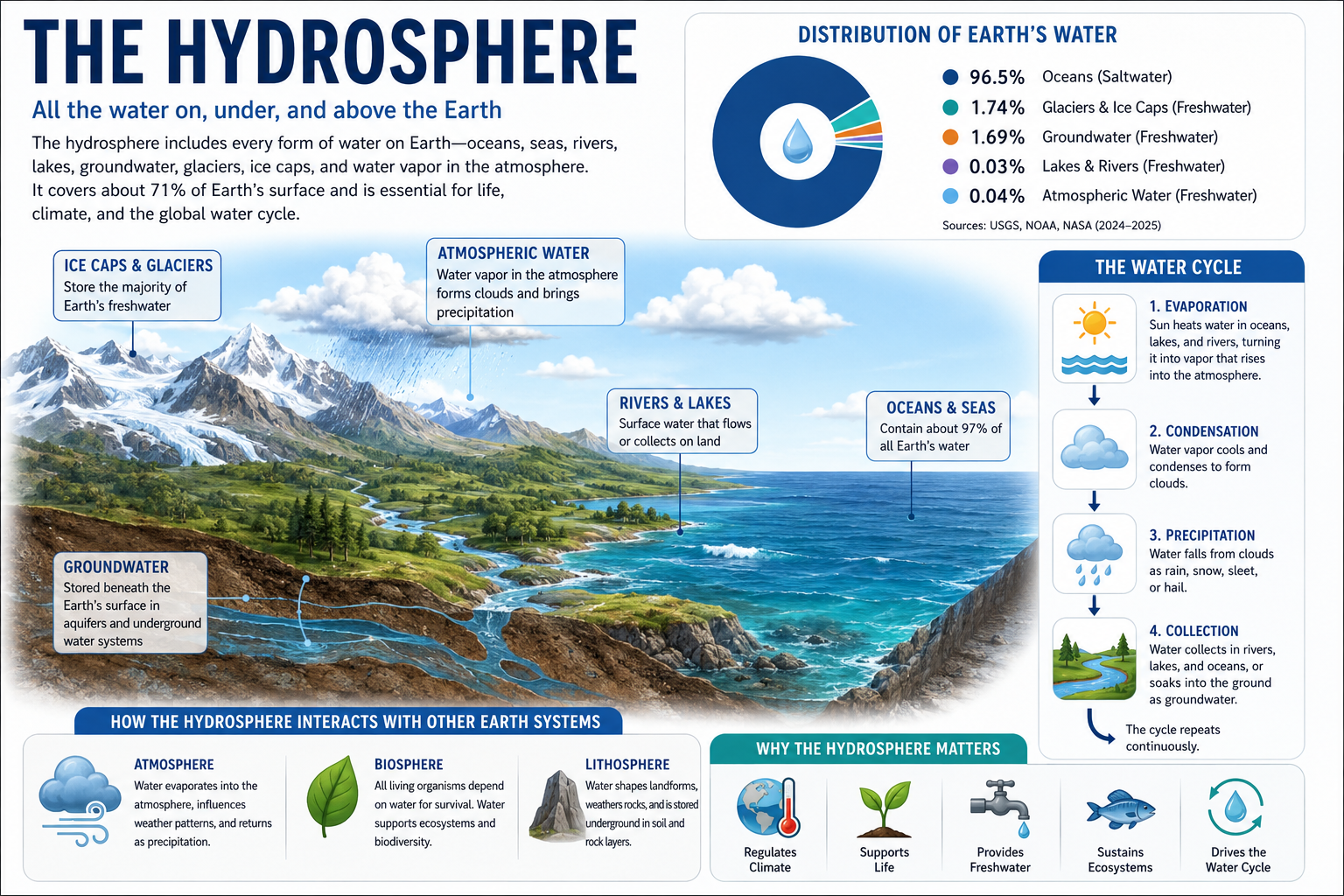
Hydrosphere is the total collection of water found on Earth, including oceans, rivers, lakes, groundwater, glaciers, ice caps, and water vapor in the atmosphere. Together, these water reservoirs form a dynamic system that supports life and drives the global water cycle.
The hydrosphere interacts continuously with Earth’s other systems. Water evaporates into the atmosphere, falls as precipitation, flows across land, and supports ecosystems within the biosphere.
Scientists study the hydrosphere to understand climate change, water resources, weather patterns, and environmental sustainability.
Why the Hydrosphere Matters
Beyond simply storing water, the hydrosphere regulates global temperatures and distributes energy around the planet.
Think of the hydrosphere as Earth’s cooling system. Oceans absorb heat during warm periods and release it gradually, helping stabilize climate conditions.
According to the U.S. Geological Survey (USGS), approximately 97% of Earth’s water is saltwater, while only about 3% is freshwater.
Components of the Hydrosphere
Oceans and Seas
Oceans contain the largest share of Earth’s water and influence weather systems across continents.
Groundwater
Groundwater stored in aquifers supplies drinking water to billions of people worldwide.
Glaciers and Ice Caps
Most freshwater is locked within glaciers and polar ice caps.
Water Vapor in the Atmosphere
Although atmospheric water represents a small percentage of total water, it plays a critical role in weather and climate.
Hydrosphere and the Water Cycle
The hydrosphere remains active through the water cycle.
Evaporation
Solar energy causes water from oceans, lakes, and rivers to evaporate.
Condensation
Water vapor cools and forms clouds in the atmosphere.
Precipitation
Water returns to Earth as rain, snow, sleet, or hail.
Collection
Water collects in rivers, lakes, groundwater systems, and oceans before the cycle repeats.
Benefits of the Hydrosphere
Supports Life
Every known living organism depends on water for survival.
Regulates Climate
Oceans help moderate temperatures and influence global weather patterns.
Supports Agriculture
Freshwater resources make food production possible.
Powers Ecosystems
Aquatic ecosystems support biodiversity across the biosphere.
Human Impact on the Hydrosphere
As of 2026, freshwater management has become a growing global challenge due to climate change, population growth, and pollution.
Industrial waste, plastic pollution, and excessive groundwater extraction place pressure on water systems worldwide.
In my experience analyzing environmental education content, one of the most overlooked issues is groundwater depletion. Many communities consume groundwater faster than natural recharge rates can replace it.
Step-by-Step: Understanding the Hydrosphere
[SCHEMA: HowTo — implement structured data on this section]
- Identify Water Sources
Examine oceans, rivers, lakes, groundwater, glaciers, and atmospheric moisture. - Understand Water Storage
Learn where Earth’s water is stored and in what proportions. - Study the Water Cycle
Follow evaporation, condensation, precipitation, and collection. - Explore System Interactions
Observe how the hydrosphere interacts with the atmosphere, biosphere, and lithosphere. - Evaluate Human Influence
Analyze pollution, water use, and climate-related changes.
Hydrosphere Data Table
Table: Distribution of Earth’s Water
[UX NOTE: Implement as styled HTML table for better engagement]
| Water Source | Approximate Share | Water Type |
|---|---|---|
| Oceans | 96.5% | Saltwater |
| Glaciers & Ice Caps | 1.74% | Freshwater |
| Groundwater | 1.69% | Mostly Freshwater |
| Lakes & Rivers | Less than 0.03% | Freshwater |
Common Mistakes to Avoid
- Assuming all water is usable — Most water on Earth is saltwater and unsuitable for direct human consumption.
- Ignoring groundwater — Groundwater supplies a significant portion of global freshwater needs.
- Confusing weather with climate — Hydrosphere processes affect both but operate on different timescales.
- Overlooking atmospheric water — Even small amounts of water vapor strongly influence weather systems.
- Believing water resources are unlimited — Freshwater availability varies significantly by region.
Expert Tips for Understanding Hydrosphere
Tip 1: Focus on Interconnections
The hydrosphere rarely operates alone. Study its links with the atmosphere, biosphere, and lithosphere.
Tip 2: Think in Cycles
Water constantly moves. Viewing water as a cycle rather than a static resource improves understanding.
Tip 3: Don’t Overemphasize Oceans
Most educational resources focus heavily on oceans, but freshwater systems often matter more for human societies.
Key Facts and Numbers
- Earth’s surface is approximately 71% water-covered.
- Around 97% of Earth’s water is saltwater.
- Roughly 3% is freshwater.
- Most freshwater exists in glaciers and ice caps.
- Water vapor drives weather formation globally.
Frequently Asked Questions
[SCHEMA: FAQ — implement structured data on this section]
What is the hydrosphere in simple terms?
The hydrosphere includes all water on Earth, including oceans, rivers, lakes, groundwater, glaciers, and water vapor in the atmosphere.
Why is the hydrosphere important?
The hydrosphere supports life, regulates climate, provides freshwater, and drives the water cycle that sustains ecosystems.
What are the main parts of the hydrosphere?
The main components are oceans, seas, rivers, lakes, groundwater, glaciers, ice caps, and atmospheric water vapor.
How does the hydrosphere interact with the atmosphere?
Water evaporates into the atmosphere, forms clouds, and returns through precipitation, creating the water cycle.
Is groundwater part of the hydrosphere?
Yes. Groundwater stored beneath Earth’s surface is a major component of the hydrosphere and an important freshwater resource.
Conclusion
The hydrosphere is the complete system of water on Earth, connecting oceans, rivers, groundwater, glaciers, and atmospheric moisture. It regulates climate, supports ecosystems, and sustains life through the water cycle. To better understand Earth’s environmental systems, start by examining how the hydrosphere interacts with the atmosphere, biosphere, and lithosphere.