
Featured Snippet (Quick Answer – 40–60 words)
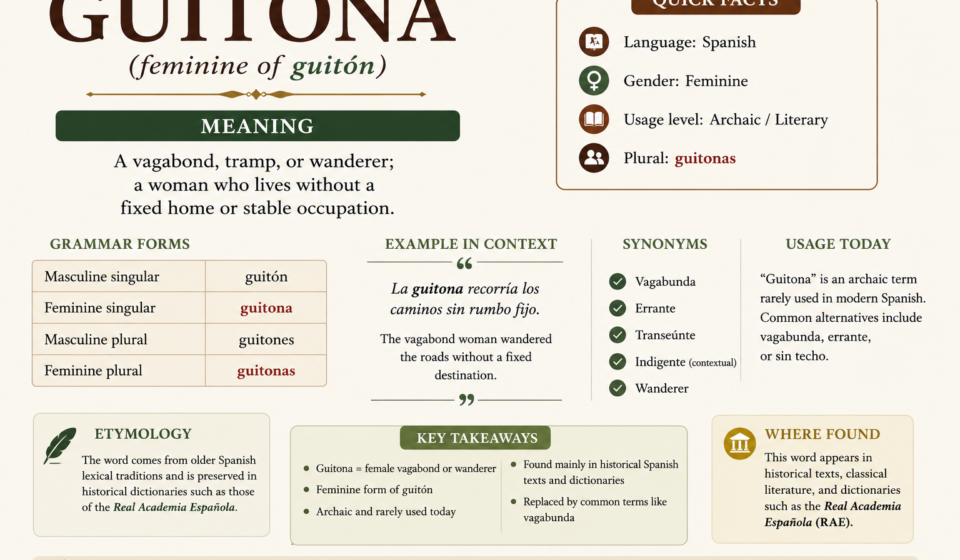
Guitona is a Spanish noun (feminine of guitón) meaning a vagabond, tramp, or wanderer. It is an archaic or literary term used to describe a person who lives without a fixed home or stable occupation. The word is rarely used in modern Spanish.
Quick Answer Box
- Word: guitona
- Language: Spanish
- Meaning: Female vagabond / tramp / wanderer
- Masculine form: guitón
- Usage level: Archaic / literary
- Plural: guitonas
Introduction
The keyword “guitona” refers to a Spanish word that appears in historical and dictionary sources rather than modern everyday language. Understanding guitona requires looking at its masculine form guitón, its grammatical structure, and its meaning within older Spanish vocabulary. This guide breaks down everything users need to know about guitona meaning, usage, and linguistic background.
What is Guitona? (Primary Keyword Section)
The term guitona is the feminine form of the Spanish noun guitón. It describes a woman who lives as a vagabond, tramp, or wanderer, often without stable work, home, or direction in life.
In modern usage, the word is considered:
- Archaic
- Literary
- Rare in spoken Spanish
Key Meaning
A guitona is essentially:
A woman who travels or lives without a fixed home, often surviving through informal or unstable means.
Etymology and Origin of Guitona
The word comes from older Spanish lexical traditions and is preserved in historical dictionaries like the Real Academia Española.
While exact etymology is debated, it is generally linked to older Iberian expressions describing wandering or idle individuals.
Grammar Breakdown of Guitona
Understanding the structure helps clarify usage:
| Form | Word |
|---|---|
| Masculine singular | guitón |
| Feminine singular | guitona |
| Masculine plural | guitones |
| Feminine plural | guitonas |
Gender Usage Insight
Spanish nouns often change form by gender, and guitona is a direct feminine adaptation of guitón.
Usage of Guitona in Sentences
Historical / Literary Example
- La guitona recorría los caminos sin rumbo fijo.
→ The vagabond woman wandered the roads without a fixed destination.
Contextual Meaning
In literature, the word may describe:
- Poor wanderers
- Social outcasts
- Traveling women without stable livelihood
Is “Guitona” Used Today?
In modern Spanish, guitona is rarely used. Instead, more common terms include:
- vagabunda (female vagabond)
- errante (wanderer)
- sin techo (homeless person)
Why It Disappeared
- Language modernization
- Preference for neutral or common vocabulary
- Shift toward socially sensitive terminology
Synonyms and Related Words
- Vagabunda
- Errante
- Transeúnte
- Indigente (context-dependent)
- Wanderer (English equivalent)
Cultural and Linguistic Context
Words like guitona are part of older Spanish literary tradition, often appearing in:
- Classical literature
- Historical dictionaries
- Regional storytelling
They provide insight into how social classes and lifestyles were described in earlier centuries.
Key Takeaways
- Guitona = female vagabond or wanderer
- It is the feminine form of guitón
- The word is archaic and rarely used today
- Found mainly in historical Spanish texts and dictionaries
- Replaced in modern Spanish by more common terms like vagabunda
5. FAQ Section
What does guitona mean in Spanish?
It means a woman who lives as a vagabond or wanderer without a fixed home or job.
Is guitona still used today?
No, it is considered archaic and appears mainly in historical or literary contexts.
What is the masculine form of guitona?
The masculine form is guitón.
Is guitona offensive?
Not necessarily, but it can sound outdated or insensitive in modern usage.
Where is guitona found?
It appears in historical dictionaries like those of the Real Academia Española.